
The Appeal of Pandora
What serious filmmakers see in Avatar that cinephiles miss
— cale, published Feb 28, 2026
It’s all too common for cinephiles to look down their noses at Avatar. I understand. They mentally put these movies in the same bucket as superhero blockbuster slop. However, in recent times, critically acclaimed filmmakers have come out of the woodwork praising not just the first Avatar film, but also the latest entry, Fire and Ash.
For example, Michael Mann (Heat, The Insider, Collateral, The Last of the Mohicans) recently named Avatar: Fire and Ash his favorite film of 2025. Mann said the following:
Jim began with a blank piece of paper. No writer-director I can think of has invented as large a three-dimensional world of his own imagining as has Jim. “Fire and Ash” on its own is an incredible achievement. There are two more installments to come. From some point in the future, when regarded historically, the whole of “Avatar” will be seen as the magnum opus it truly is.
For those of us that think of these movies as something akin to Transformers, this should give us pause.
The Spectacle
Isn’t Avatar just a big technology spectacle? Isn’t it just meant to dazzle? Well, yes. The director of the films, James Cameron, likes to push the boundaries with new technology. But people forget that film has always been about giving the audience new experiences with new technology. When motion pictures with sound were first invented, many artists (including Alfred Hitchcock) saw it as entertainment and nothing more. Twenty-four frames per second, sound, the dolly, the steadycam, 3D, so it goes.
Jim’s theory behind this is that if we want audiences to see movies in theaters, we need to make them worth seeing in theaters. Film is fundamentally visual, after all. So seemingly, the real concern from cinephiles is that there is nothing beyond the spectacle; nothing under the surface.
My Experience
I saw Avatar much later than its original release date of 2009. I was too busy with my freshman year of college to make time for a “Fern Gully knock-off”. One Summer day in 2012, when I was working on the packing line at a furniture factory, my Juggalo co-worker told me about how much he loved this movie. The next day he brought me the DVD from his collection. When my shift ended at 10pm, I cracked open the Barefoot Moscato and put it on my 27” CRT fullscreen living room television.
I couldn’t explain it then, but I was astounded by what I saw. The world of Pandora provided a genuine escape from the mundanity of my “2 to 10” job. This was back before I had a smartphone, so my attention span was a non-issue. Regardless, I was engrossed in the story. Was it similar to Fern Gully? Yes. Did that matter in the moment? No, not at all. For Avatar, it was more so about how good the execution of the idea was. Nevertheless, I told my coworker how much I loved the movie and really just left it at that.
A decade later, Avatar: The Way of Water came out. For whatever reason, the same thing happened where this whole event just passed me by. Fast forward again three years and Avatar: Fire and Ash comes out. Youtube recommended me a slew of behind the scenes footage along with James Cameron interviews nerding out about the technology behind it all. I have to admit that I got interested in this in an ironic way at first. “Yes,” I thought, “Avatar is the best thing ever and I’m going to see the new one.” We know how it goes, though. Irony gives way to sincerity.
I sat down and watched Avatar (2009) and Avatar: The Way of Water (2022) back-to-back to get ready for the new one. When you approach things from an ironic standpoint, you have an immense suspension of disbelief. It was this suspension that allowed me to become fully engrossed in what I was seeing. The thought of “what if it’s bad” or “what if it’s cheesy” never crossed my mind. I was just completely receptive to the journey on which Cameron wanted to take me.
Humans need to become friends with the native beings so they grow lifeless husks of these beings and pilot them with their consciousness? Makes sense. Oh, and these beings are also very sexy? Even better.
It’s so preposterous that it becomes compelling again. “How could someone actually write this story,” one thinks.
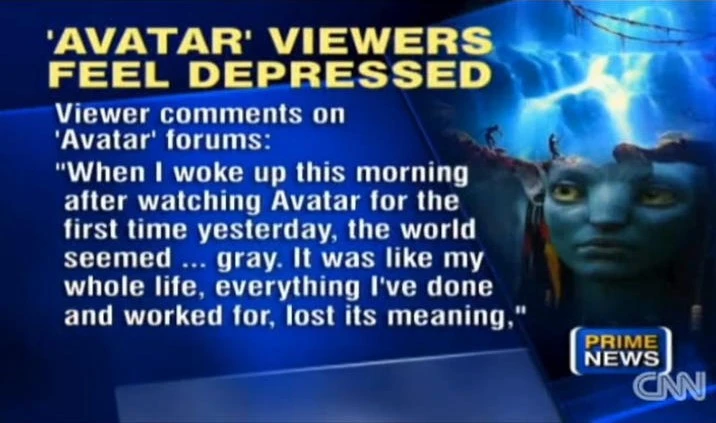
When you go into these movies, you’re going to see something you’ve never seen before. It sounds so simple, but think of all the movies out there with shots that you’ve seen hundreds of times. Cameron presents a visual feast that is so novel, so inventive and stimulating, that you will certainly go into a depression after consuming it.
It’s something special when you see a movie and think “God, I want that to be real”. It’s a kind of magic spell that gets the whole world manifesting a certain positive reality. Which is exactly what Cameron wants with the strong political themes in the series.
Characters and Performances
Beyond the basic concept behind the story, I was genuinely impressed by the actors’ performances. The dialogue is simple and direct while also managing to be memorable. It’s borderline pulp; that is to say, it’s actually fun. And similar to Star Wars, the actors more than ‘make do’. They own it. It’s been a long time since I had dialogue “earworms” stuck in my head. I’m still saying “You’re like a baby, making noise, don’t know what to do” in Neytiri’s voice months later.
Bradley Cooper (A Star is Born, Maestro, Silver Linings Playbook) recently went on a rant about his love for the Avatar series, saying the following:
I saw a movie the other night that I didn’t believe anybody in it. But I love Avatar. We watched 3, then 2, then 1. I had just gone from watching this movie where I didn’t believe anything anybody was doing; the whole time. Then I’m watching Avatar for 2 seconds and they’re on a thing and they’re blue, but they’re talking to each other … By the way I’m like, when’s 4 and 5?
Cooper is also shocked by how utterly believable these performances are despite being high fantasy/sci-fi.
In a Q&A event, Jim said:
There is an intimacy and sense of reality in the character moments despite all the world-building. […] People often ask me “when are you going to do something small and intimate?” Well, I do on every one of these movies. I just don’t just do that. […] The scene [in Fire and Ash] where Neytiri and Jake challenge each other about them being an interracial marriage with mixed race children, and it just devastates her, and he tries to apologize, but you see that she isn’t buying the whole ‘family as a fortress’ thing anymore… I’m probably more proud of that scene than the whole battle at the end. Just because it was simple and it was clean. It was just writing and acting.
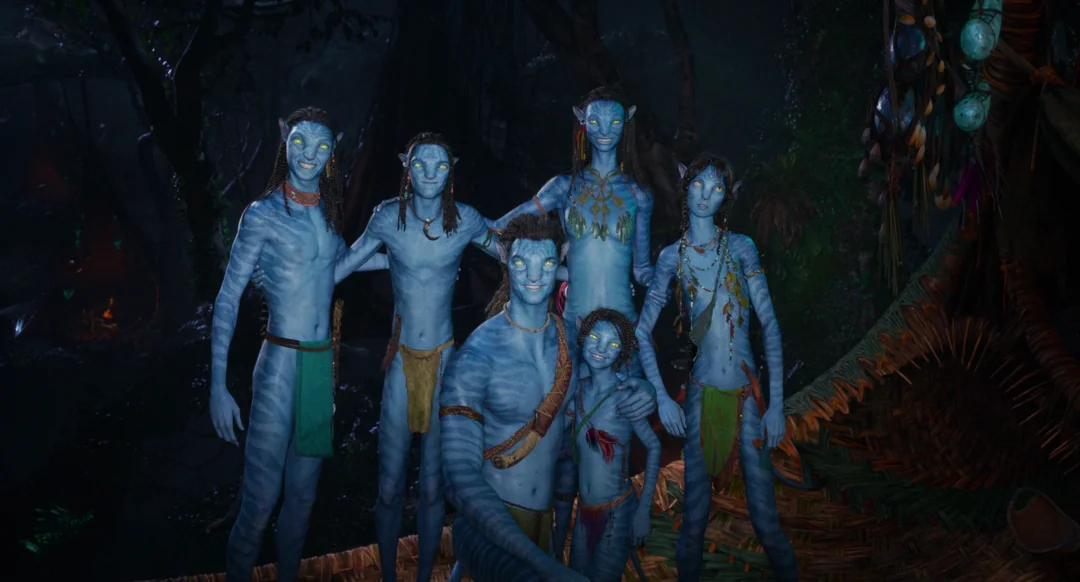
In The Way of Water, the world and lore expands tenfold. You’re not only drawn deeper into Pandora, but you’re drawn deeper into the inner worlds of the characters. Now having older children himself, Cameron writes a family drama from a view of experience. The underlying strained relationships between husband and wife, parents and children; thinking back, it’s all evident from the family portrait in the first 10 minutes of the movie.
Yes, the spectacle is still there. I’ve never seen water look so good in a movie before. But if it wasn’t evident from the first movie that character and performance is a first class citizen, Way of Water makes it so.
Fire and Ash can really be thought of as Part 2 of The Way of Water. Originally, it was just one script. Cameron later split the script into two. When thought of this way, Fire and Ash is an excellent installment. This time around, the world doesn’t expand nearly as much. The characters play in the same sandbox; which is great, because it allows the focus to be much more on the story and drama and characters (see the quote from Cameron above).
Mythology
Where the world does expand in Fire and Ash, it expands deeper rather than more broadly. We go deeper into things like the nature of Eywa (the deity that is worshipped by the native beings) and how the “rules” of the world work. There is a 3 second clip in Fire and Ash that solidified for me that Cameron is willing to get weird with this. It reminds me of what George Lucas wished he could have done with a Star Wars sequel trilogy.
Guillermo Del Toro (Pan’s Labyrinth, The Shape of Water, Frankenstein) summed up his love for Avatar like this:
There are very few Americans that have created a full mythology. You have (George) Lucas, the whole Wizard of Oz mythology with Frank Baum, and Jim is creating that with Avatar. It’s gonna take you places.
Fire and Ash definitely makes me believe that the next stories are going places that we do not expect. Not many people know that Del Toro and Cameron briefly lived together in LA in the 90s. Del Toro has said that he and Jim would spend many hours watching anime together.
Knowing that Cameron is a fan of anime explains a lot. Like anime, the world and lore of Avatar is completely unrestricted (there are no technical limitations or producer meddling).
There is also a level of sincerity in Avatar that is only matched by anime, which westerners see as refreshingly void of irony or self-awareness. Avatar is the closest thing to authentic American Anime that we have and Cameron is an auteur filmmaker akin to Mamoru Oshii (Ghost in the Shell) or Hayao Miyazaki (Princess Mononoke, Nausicaä of the Valley of the Wind). You can see recurring themes and devices across the body of his work because he has the skill (and the will) to manifest these things in his projects. For Cameron, it’s the hubris of human achievement against the sheer power of nature. It’s the white picket fence fantasy of family vs its messy reality. It’s a tactile blue-collar environment full of buttons and switches and knobs and hoses.
Despite there being wildly different technical contexts across all of Cameron’s films, he maintains a consistent vision and voice. And what he produces with the Avatar movies is the most “Cameron” stuff yet, synthesizing everything he’s done before.
If I, or Michael Mann, or Bradley Cooper, or Guillermo Del Toro have inspired you to go back and watch these movies again, do so with new eyes. Just be careful. There’s no cure for Post-Avatar Depression.