
The Puffy Chair: 20th Anniversary Screening and Q&A
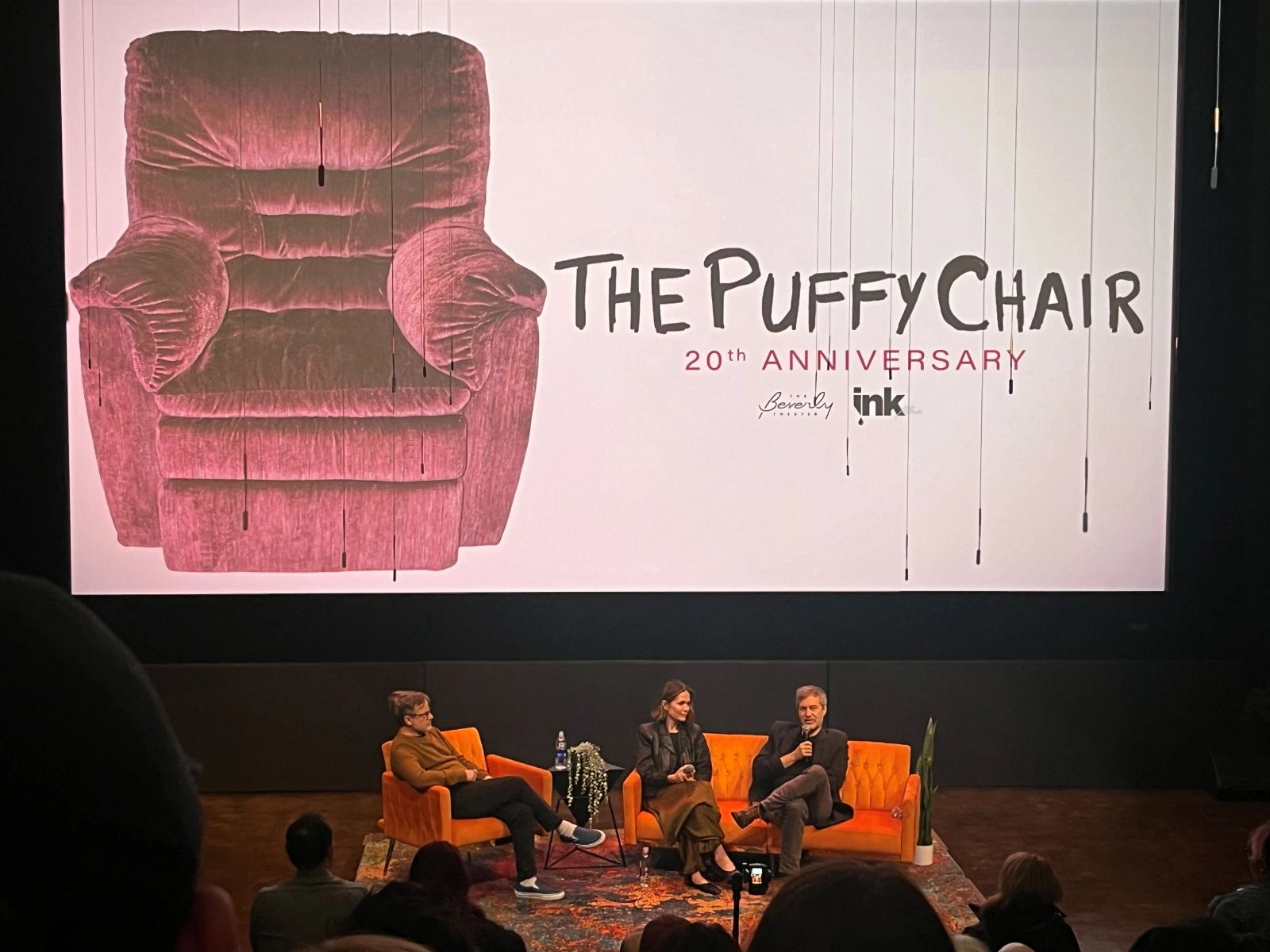
Mark Duplass and Katie Aselton visit Las Vegas for the re-release event
— jeff, published Feb 25, 2026
When The Puffy Chair wrapped filming 20 years ago, the Duplass Brothers saw it as a scrappy, low budget, minimalistic film, and an obvious labour of love. They slept and worked in the very van that Mark Duplass drives in the film, and the entire film is colored by the real-life relationship and the natural improvisation of Mark Duplass and his then girlfriend, Katie Aselton. The film had an impossibly small crew consisting mainly of the cast, and of course, Mark’s brother Jay Duplass behind the camera.
The reception to the film, however, was anything but small or scrappy, and the film (and the Duplass Brothers) received a sudden mass of accolades and notoriety. More importantly, the success of The Puffy Chair helped to legitimize mumblecore films’ aesthetic and tactics as a viable strategy to actually make a living from film. The Puffy Chair inspired an entire generation of filmmakers to pick up whatever shitty camera and mic they could afford, and to go out and make something- anything- that they were passionate about.
Collaborators like Greta Gerwig, and prospective film makers like the Safdie brothers, were clearly inspired by the early days of mumblecore, and The Puffy Chair was really a massive inspiration to basically anyone with an empty wallet and a dream. Without The Puffy Chair, a momentous film like Francis Ha may never have gotten the funding it needed to even begin shooting.
Now, 20 years later, we’re sitting in a theater with about 100 other people in preparation to rewatch The Puffy Chair, which was lovingly re-released by Ink Films and shown at the Beverly Theater in downtown Las Vegas.
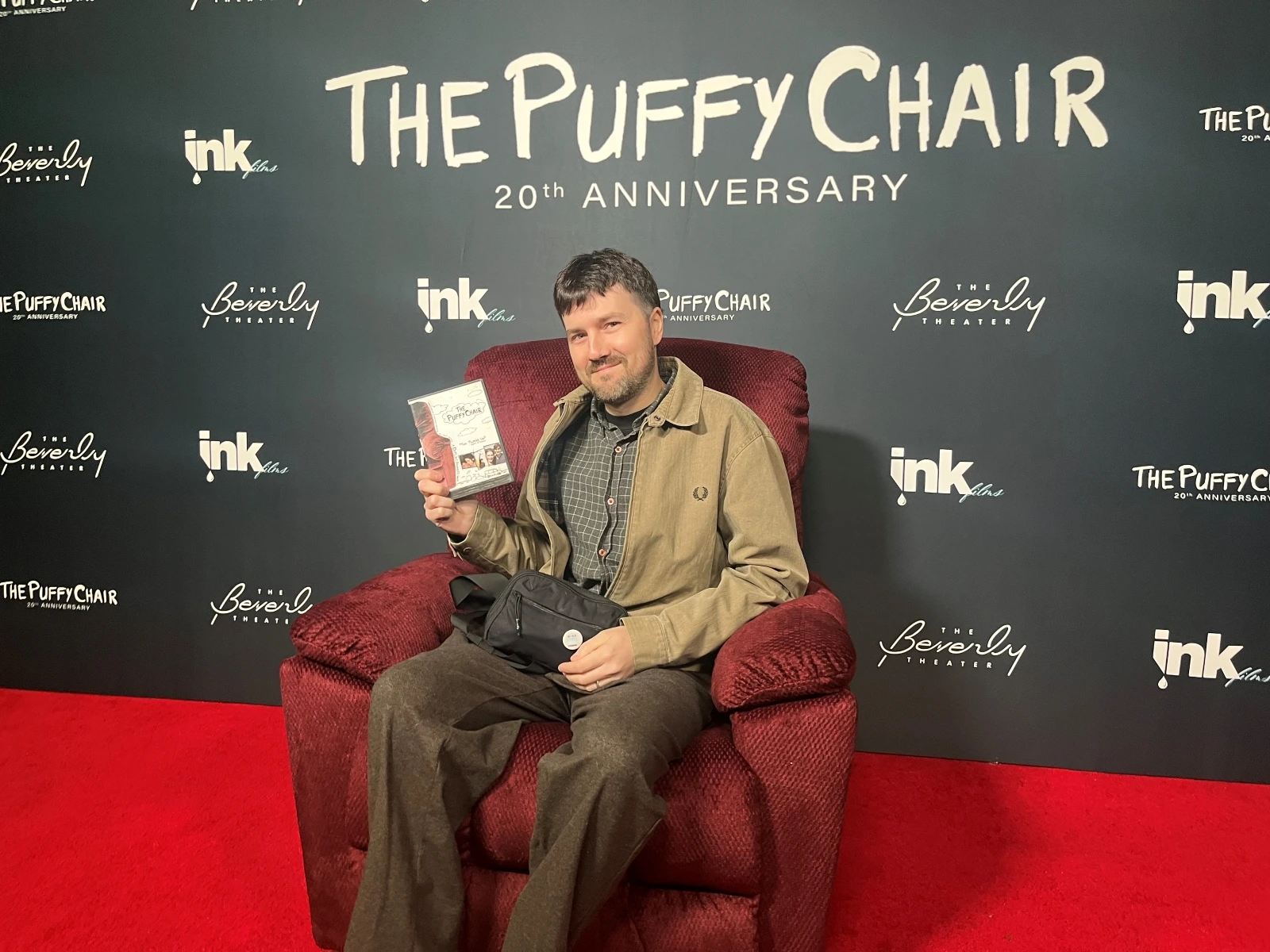
Seeing the film again for the first time in over a decade, I was reminded of what made me such a big fan of the Duplass Brothers to begin with; that scrappy sincerity, and their clear love for their flawed characters shown bright on the screen, and an entire audience of young people and prospective filmmakers were now watching the film for the first time.
After the credits rolled, Mark Duplass and Katie Aselton came out and discussed their early career, as well as the process of how The Puffy Chair came to be. The discussion was guided by Mike Plante, the Senior Programmer for Short Film at Sundance Film Festival.
Read or watch the first 10 minutes of Q&A
Katie Aselton: This is so cool!
Mark Duplass: Oh, wow! What a radical act, you all came to see a movie in a movie theater that you could have streamed online! This is rebellion. You guys are fucking awesome.
Katie Aselton: This is so cool!
Mark Duplass: Oh, wow! What a radical act, you all came to see a movie in a movie theater that you could have streamed online! This is rebellion. You guys are fucking awesome.
Mike Plante: You know, they actually want to ask: Is this anyone’s [in the audience] first time you've seen The Puffy Chair?
(most of the audience raises their hands “yes”)
Mark: What?! What are you doing?! I'm so grateful.
Katie: Were you like, “what is this?! This [film] looks terrible!”....You’re right, it does! But oh, man. I'm proud of what we did.
Mike: And also, Mark and Katie were jealous that you [the audience] get to see this for the first time. Yeah, because it's a movie that should be seen in theaters.
We had a screening in L.A., and It was the first time you had both seen it in quite a while.
Katie: Since 2005.
Mike: Do you have emotions?
Katie: I was I mean, I looked so good...even in low-res! My skin is...poreless!
Mark: The whole night, it was just a new comment every 30 seconds, we were laying in bed, like, “I wasn’t even wearing any makeup!” then you’d be quiet for a little bit.
Katie: I, um, it was such a strange experience to make this movie because it really was just us making a movie and making it up as we went along in a lot of ways. And so when it premiered at Sundance and, and got bought, and all these things, I was just like, “I don’t get it!”
I was so confused, I was like, “but this isn't how movies are made…” It was very, like, hard to process at the time, and I think there was a little part of me that was like, it's this small, it's tiny, it's whatever! We didn’t know what we were doing! And then I just watched it, and it's in L.A., we just sat there and thought, Holy shit, it's beautiful.
It really is...I'm really so proud of what we made, and I couldn't see it [back] when we made it because we were young and by ourselves.
Mark: I just was in an existential time machine watching it again, because, you know, the people who play Josh, my character's parents, that's my mom and my dad, and, like, my dad is only seven years older than I am now.
Our oldest daughter is 18, is an actress and looks just like Katie, who was 24 making this movie. And so I was just like, I was in Everything, Everywhere, All at Once. I was just like, “I don't know what's happening!”
Mike: And you had made some attempts at making features before this, were they sort of straight, like dolly shots, and professional acting?
Mark: Yeah. I mean, I think our journey to get here was a very circuitous one.
You know, you hear those stories, in the 90s, you know, there's all those stories of just like, you know, “maxed out my credit cards and made my $30,000, 60mm film” and it was great back then. And, you know, that was not us.
We [Mark and Jay Duplass] worked as editors for a long time. And we made a lot of bad, bad 16 millimeter short films.
And then we eventually saved up enough money, and we we made this documentary for one of those fortune 500 companies called Carton, and they were in Austin and we were living there, and we under-bid them and said, “yeah, give us 200,000$ and we’ll make you a documentary”. And they were like, “oh, that's so cheap”.
So, we made them a documentary for $15,000.
And then, you know, we took a bunch of that money and we made what was going to be the next great independent film—which was not this [The Puffy Chair], this is a movie no one has ever seen.
And, so yes, we were doing dolly shots, we were doing scripted dialog, we were doing a lot of the things that we loved watching, you know, like the Coen brothers—that sense of control and cinema.
I think we thought that's what we were going to be. But, it turns out we weren't good at that.
And then it was literally one day, and we were in our kitchen and it was 2003, and Jay [Duplass] and I grabbed our parents video camera, just me and Jay, we made this little short film improvised in the kitchen on a larp, and sent it to Sundance.
And in the first program they watched it, and it was like, “this looks like shit, this sounds like shit and it is shit—put it in the rejection file.”
And then someone else was there—and it was Mike Plante, from the Sundance program. And he saw, in this little film—and it was the ugliest and worst sounding film to ever play Sundance.
Katie: Maybe ever.
Mark: Yeah, maybe ever! But, he saw something in there and programmed us in Sundance.
So, I guess that's my long way of saying, that short film created a new methodology for us, which was, stumbling into the art, trusting our instincts and going with the improvisation and, and trying to build something that was in front of us.
The chase of that, all led us to this, The Puffy Chair. It was seven of us, cast and crew total. The van was the production vehicle, and also the picture vehicle.
I was a musician, so I had that van at the time, I mean, and we just we built this $10,000 movie around what I—what we—love to call the the “available materials school of filmmaking”.
For the film, we found two identical chairs for 500 bucks, and we can light one of those sons of bitches on fire.
Katie: That chair was not flammable!
Mark: No, it was not! Yeah. They really, they knew we were for them.
Katie: setting that thing on fire was the hardest thing that we have ever done.
Mike: Katie, What did you do before this?
Katie: I had literally just graduated acting school the day before we started shooting. And so I was learning...for theater/film. I was at a theatre school in New York, and I had lived in L.A. Before that and got a couple jobs—baseball, TV jobs. And I realized that I was like, not very good there.
So, I went to school, I graduated, and in the middle of school, we had done Scrapple, which was their [Duplass Brother’s] second short film. And that also went to Sundance the following year.
And then was this—well—my teachers threatened to throw me out of school! And I was like, “okayy”, they did! And so I graduated and ended up going into The Puffy Chair.
Mike: And a lot of people talk about the cheapness of [The Puffy Chair] but it sort of wouldn’t work if it wasn’t believable—the characters, the love story. And a lot of us connect to that, for some bad reasons, too. Many people think you were just acting out a bunch of stuff—but, like how much of it was scripted and how much was based on your and Mark’s relationship? Because you acted as a couple a few times.
Mark: It was really interesting because, you know, this central love story of The Puffy Chair is essentially, “Shit or get off the pot”, right? Like, are we going to get married, or are we going to break up, or are we going to give each other the best years of our lives?
The story is in search of that: should we cut it [the relationship] Now? And this was the epidemic sweeping through our friend groups at the time. Particularly, we found that, like those of us who were struggling artists, giving so much of ourselves to the arts, so afraid we weren't going to make it, so afraid there wasn’t going to be enough Money. And during that time, I still had like, that southern male, “I got to go make a living before I can get serious with a girl, and provide for her” mentality.
And so, so all that soon was evident in me and Katie’s relationship, and it was evident in Jay (Duplass) and his girlfriend—now his wife—and evident in all of our friends. We felt like this is the thing that we're dealing with. You know, they always say, if you're under 30 and your film-making skills are not that developed, that you should just make something as close to home as possible, so you can get the truth in there. And we felt like that was something we knew about. We have those conversations late at night, you know?
Katie: Yeah, and while it wasn't like based on us, I definitely got to say things that I wanted to say in The Puffy Chair, but it was all in the guise that I’m in character.
Mike: Was there weirdness after some of your dates after [those intimate scenes]?
Katie: No, I felt very clear.
Mark Duplass came across as one of the most genuine and humble actors/producers/directors that we’ve ever had the pleasure of meeting, and he stayed for far longer than we thought, with the Q&A clocking in at a little over an hour.
Mark and his wife went into the intimate details relating to the creation of the movie, along with many other questions related to their now long and storied career in Hollywood.
Mark told the audience that filming The Puffy Chair was the freest and most creatively in-control he’s ever been while crafting a film. He followed this up by describing his experience with their most commercially successful film, Cyrus, as being a “dogfight” in terms of creative control. He warned future filmmakers in the audience about the strings that always come with funding, so we ended up asking a question about their follow up to The Puffy Chair, 2008’s Baghead.
Slowburn: “Mark, you mentioned the creative control and freedom you had as a small crew when you filmed Puffy Chair, and your struggle with producer meddling while shooting Cyrus- when you filmed Baghead a few years after Puffy Chair blew up, were you able to maintain the same style of small crew and creative control as with Puffy Chair?”
Mark Duplass:
So this was made for about $10,000 to $15,000, roughly. Of course, it gets more expensive when you go to Sundance, you have to do all that stuff without production and getting it done. So for Baghead, Katie and I moved to LA, we got our agents, and it was a little easier to get writing and directing work than it was for us to get acting work, for whatever reason.
Jay and I signed a blind deal with Universal to write a script that paid us $100,000. Holy shit. So it was like, immediately, what do you do? We gotta blow this on another project!
So we wrote Baghead, well, we had a couple of studio movies in development, one of them was Cyrus, and I was like, I can make this for $50,000 where everybody gets maybe a little bit, and I could use some of this Universal money to pay for it.
Everybody in the industry really responded to us as a team after The Puffy Chair, and everybody was like, ‘we want to fund the next movie, we want to fund it!’.
So, I came up with a model in my mind, I was like, I’m going to go out and ask these people for $250,000, I’m going to offer them a 50% return on their investment. So, we get to go to Sundance and sell it big, they [the buyer] can do well, but my only rule is, they just have to cut (us) the check.
I’ll give them all the producer credits, I’ll make them look cool, pictures on the red carpet, but I gotta do the thing [maintain creative control]. And then all- I mean, like 15 people came flying in. I was like, yes, of course, of course.
I started making phone calls, one by one. [I thought] Absolutely, just cut us the check. They just kept saying the same thing, “…well, there’s just this one thing about the ending, can we change that?” and we just went, “nope”.
Then it was, “but would you consider casting this person? She’s an actress on the WB”. We said “nope”. It just kept coming and kept coming, so we literally couldn’t find any financier who would do what we wanted, so we paid for it ourselves. Then I was like, ahh, we can’t live without paying ourselves. And then we brought it to Sundance, and we sold it for like a high six-figure deal.
And in that moment, we sort of realized like- oh, this actually might be better- to own our own stuff. And I kind of precipitated that model going forward- to try to pay for things ourselves.
Mike Plante: “And did you give your parents back the 15 grand [for financing The Puffy Chair]?”
Mark:
We never paid them back. Yeah. They’ll be the first ones to tell you that. No, they were great about it [laughs].
Ink Films is planning more cities for the re-release and Q&A tour, so follow them to keep up with where they’re headed next.
Thank you all for reading, and go enjoy some Duplass films!