<?xml version="1.0" encoding="utf-8"?><feed xmlns="http://www.w3.org/2005/Atom" ><generator uri="https://jekyllrb.com/" version="3.10.0">Jekyll</generator><link href="https://slowburn.mov/feed.xml" rel="self" type="application/atom+xml" /><link href="https://slowburn.mov/" rel="alternate" type="text/html" /><updated>2026-09-22T18:44:39+00:00</updated><id>https://slowburn.mov/feed.xml</id><title type="html">Slowburn</title><subtitle>Movie reviews and culture</subtitle><author><name>Slowburn</name></author><entry><title type="html">Resident Evil</title><link href="https://slowburn.mov/resident-evil/" rel="alternate" type="text/html" title="Resident Evil" /><published>2026-09-19T00:00:00+00:00</published><updated>2026-09-19T00:00:00+00:00</updated><id>https://slowburn.mov/resident-evil</id><content type="html" xml:base="https://slowburn.mov/resident-evil/"><![CDATA[<p>Zach Cregger is intimately familiar with the video game experience. He knows about receiving (and immediately disregarding) instructions from NPCs. He knows about starting an optional side-quest and “nope”-ing out when you realize it’s not worth it. And he, most importantly, knows that snow levels are always the best.</p>

<p><cite>Resident Evil</cite> is a reboot of the franchise that asks nothing of its audience other than “be ready to have fun”. The story also serves as a prequel to the universe that tees up future films for a home run. For that reason, it did earn the prestigious, eponymous title. Everyone that had a great time watching this will no doubt see any future installment that follows and builds upon this (simple) foundation.</p>

<p>The first half of the movie harkens back to some of my favorite horror thrillers: <cite>30 Days of Night</cite> and <cite>The Thing</cite>. Not just because of the snow, but also because of the gritty “no hot people” aesthetic (which is sneakily the hottest aesthetic a movie could have).</p>

<p>Cregger re-united with Ryan and Hays Holladay from <cite>Weapons</cite> for the dreadful (full of dread) synth score that will find you involutarily furrowing your brow and gritting your teeth. It’s the kind of soundscape that feels like it arises naturally when you’re just thinking about the story. In some way, it’s like a more ambient, modernized GoldenEye N64 soundtrack.</p>

<p>Several tense action sequences felt like a natural evolution of Cregger’s previous work. We see the problem solving from <cite>Barbarian</cite>, the chaotic escapes from <cite>Weapons</cite>, and this time even the humor from <cite>The Whitest Kids U’ Know</cite>.</p>

<p>Austin Abrams plays a millennial Joe Six-Pack (of Liquid Death, probably). Most of the laughs of the film are provided by Abrams’ pro choice and, presumptively, pro gun-control character being thrown into a world of violating individual autonomy and shooting people in the face. I would praise Abrams’ performance here, but it doesn’t even feel like a performance. For an actor, that may be the highest praise I could possibly give.</p>

<p>Paul Walter Hauser shows up at the midpoint and provides a well-earned respite from the action. I am a big PWH fan, but I’m not sure if the casting was correct on this one. Abrams was already playing the bumbling fool. A “straight man” against Abrams may have played stronger, and better for this side character as well.</p>

<p>Is the humor too much at times? For a standalone prequel that reintroduces the universe of <cite>Resident Evil</cite> to a wider audience, it works! However, if future sequels ever expand on this initial outbreak, they may have difficulty portraying some of these characters in a more serious light. An avoidable problem with some finagling.</p>

<p>The second half of the movie is like the latter half of a video game. Unfortunately, I only rarely finish video games once I get to the middle point. Likewise this movie didn’t hold my interest once the character was sufficiently “leveled up”. Ironically, the video games that I finish are the ones with strong stories and characters that draw me in. There is certainly a lesson in there; and I think Cregger knows it already. But regardless, this was a wild ride and definitely worth the price of admission.</p>]]></content><author><name>cale</name></author><summary type="html"><![CDATA[Zach Cregger is intimately familiar with the video game experience. He knows about receiving (and immediately disregarding) instructions from NPCs. He knows about starting an optional side-quest and “nope”-ing out when you realize it’s not worth it. And he, most importantly, knows that snow levels are always the best.]]></summary><media:thumbnail xmlns:media="http://search.yahoo.com/mrss/" url="https://slowburn.mov/assets/images/resident-evil.webp" /><media:content medium="image" url="https://slowburn.mov/assets/images/resident-evil.webp" xmlns:media="http://search.yahoo.com/mrss/" /></entry><entry><title type="html">Hope</title><link href="https://slowburn.mov/hope/" rel="alternate" type="text/html" title="Hope" /><published>2026-09-10T00:00:00+00:00</published><updated>2026-09-10T00:00:00+00:00</updated><id>https://slowburn.mov/hope</id><content type="html" xml:base="https://slowburn.mov/hope/"><![CDATA[<p><cite>Hope</cite> is a new sci-fi action film from acclaimed director Hongjin Na. In the shadow of high tensions between North and South Korea, the tight-knit, rural community of Hope Harbor must now deal with a greater foreign threat.</p>

<p>There are some common themes running through all of Hongjin Na’s films. Individualism, anarchism, xenophobia. Think Nietzsche, or better yet, Tolkien. All of this is continued in <cite>Hope</cite>, and it feels as coherent, subtle, and balanced as ever.</p>

<p>Like in <cite>The Chaser</cite>, <cite>The Yellow Sea</cite>, and <cite>The Wailing</cite>, we once again see a protagonist that must rise above the duties of his job description and see beyond the black-and-white to do what needs to be done.</p>

<p>Jungmin Hwang plays a straight-laced, local cop that just wants to follow “the book”, often placing the greater good over the individual. In one moment in the first act, a ragtag group of local elders pick up Hwang in a truck. Hwang questions if their guns are legally registered (a recurring bit that always lands) and they rightfully give him a scolding as to a silly grandchild.</p>

<p>Perhaps if the movie’s trailer put this setting and character more upfront rather than featuring monster action sequences, it would appeal to a broader American audience. After all, I felt like Hope Harbor was just like my hometown in Ohio. I knew that cop growing up, and I knew his cousin, and those townspeople. It could have been portrayed as something closer to JJ Abram’s <cite>Super 8</cite>.</p>

<p>Alongside our cop protagonist, played by Hwang, is a series of standout performances. Hoyeon (known for Squid Game) plays a rookie cop whose strong moral compass overrides her fear and brings out all of the badass energy and charisma of Ripley (Sigourney Weaver) from the <cite>Alien</cite> series. Peppered in are several townspeople that you instantly fall in love with for their bluntness and authenticity.</p>

<p>Speaking of the townspeople, <cite>Hope</cite> is by far Na’s funniest film. As in <cite>The Wailing</cite>, there is a fantastic monologue here where a character tells a story, flashing back to the events in the middle of the story. This riotously funny monologue lasted longer than it needed to, but it was geniunely the highlight of the whole 2nd act. Na often cuts his films with dry humor even in the darkest of stories. But he really went all-in this time on the eccentric, but heartfelt character interactions. One recurring “bit” about townspeople offering our protagonists food in unexpected situations displays this perfectly. None of the humor overstayed its welcome or hurt the overall tone of the movie either.</p>

<p>The antagonist faction is all played by western performers; a subtlety that could be lost on the audience if not for the blue and green eyes of the characters. I won’t say more about this because there are several delightful surprises as the story unfolds. But I can’t help but think that this story will be even more relevant as geopolitics marches on in the coming decades.</p>

<p>The production design for <cite>Hope</cite> is immersive and transporting. Whether it’s a ruined small-town storefront with wires and debris hanging from the ceiling making it look like the characters are walking into a monster’s lair, or even just an office or workshop (I think this story is set ~1995), the props, design, and decor are gorgeous and authentic. There is also a whole setting and design of the antagonist faction that will surprise you in the amount of detail and work put into the practical sets.</p>

<p>The cinematography is some of the best in Hongjin Na’s filmography. Na reunited with Kyungpyo Hong from <cite>The Wailing</cite>. Hong was also the cinematographer on <cite>Parasite</cite>. What really set <cite>Hope</cite>’s cinematography apart were the expansive, larger than life shots composed in a handheld manner. Similar to <cite>The Brutalist</cite> or something from Terrence Malick, it just felt like a breath of fresh air. Thinking back now, many of the shots were celebratory in nature; in other words, hopeful.</p>

<p>The action was extremely legible. The viewer is never confused about where things are and what’s happening. The only thing I can compare it to is James Cameron with <cite>Terminator 2</cite>. There is literally a 90’s cop car burning through the streets doing 180-degree drift turns, which is something that I didn’t realize I was sorely lacking in my visual stimulae. Another action highlight was a particular chase sequence in the 3rd act. The action involved was objectively small, but Na made it so thrilling that the audience in my screening were audibly reacting and laughing just to cut the unrelenting tension.</p>

<p>Having said all this, there were quite a few chase sequences that could possibly be trimmed down. That may push Hope a bit into <cite>Terminator 3</cite> territory rather than <cite>Terminator 2</cite>. But honestly that is a matter of taste. I never looked at my watch once during my screening and I am always one to complain about movies being too long.</p>

<p>Some of the CGI also left me a bit puzzled. It was hard to tell what was meant to be stylized and what may have been unfinished or rushed by a post-production contract that ran out of budget. If stylized, several images harken to <cite>Attack on Titan</cite>. It will be interesting to hear more about this aspect of the production as the years go on.</p>

<p>What is the “hope” in <cite>Hope</cite>? The hope of understanding? The hope of peace? The hope of life, liberty, and the pursuit of happiness, perhaps. It’s difficult to say with certainty at this time, but I am invested in the world that Na has built and the story that he is telling.</p>

<p>As this article’s subtitle alludes to, I think Hongjin Na has crafted another film that will strongly appeal to fans of classic American cinema, both in content and form. When I first watched <cite>The Chaser</cite> and <cite>The Wailing</cite> I couldn’t help but think of Spielberg, Scorsese, and Fincher.</p>

<p>In some ways, Hongjin Na is like a Korean Tarantino, taking everything he loves and blending them up into the exact movie that he wants to see. In the case of <cite>Hope</cite>, we got a delicous <cite>Godzilla</cite>, <cite>Super 8</cite>, <cite>Aliens</cite>, <cite>Tremors</cite>, <cite>Jaws</cite>, <cite>Avatar</cite>, <cite>Terminator</cite> smoothie. But that is not to say that this is a derivative story with nothing unique about it. Quite the opposite. Go see it.</p>]]></content><author><name>cale</name></author><summary type="html"><![CDATA[Hope is a new sci-fi action film from acclaimed director Hongjin Na. In the shadow of high tensions between North and South Korea, the tight-knit, rural community of Hope Harbor must now deal with a greater foreign threat.]]></summary><media:thumbnail xmlns:media="http://search.yahoo.com/mrss/" url="https://slowburn.mov/assets/images/hope.webp" /><media:content medium="image" url="https://slowburn.mov/assets/images/hope.webp" xmlns:media="http://search.yahoo.com/mrss/" /></entry><entry><title type="html">Teenage Sex and Death at Camp Miasma</title><link href="https://slowburn.mov/teenage-sex-and-death-at-camp-miasma/" rel="alternate" type="text/html" title="Teenage Sex and Death at Camp Miasma" /><published>2026-08-31T00:00:00+00:00</published><updated>2026-08-31T00:00:00+00:00</updated><id>https://slowburn.mov/teenage-sex-and-death-at-camp-miasma</id><content type="html" xml:base="https://slowburn.mov/teenage-sex-and-death-at-camp-miasma/"><![CDATA[<p>If you enjoyed director Jane Schoenbrun’s previous films, you probably knew what you were getting into with this movie. Even so, <cite>Teenage Sex and Death at Camp Miasma</cite> takes the surreality and messiness of Jane’s previous works and turns the dials up a notch.</p>

<p><cite>Miasma</cite> features a captivating but strangely uneven script. Its first half is fantastic, but its third act practically caves in on itself under the weight of too many ideas. The main concepts explore sexual identity, shifting gender dynamics, and the subversion of horror and television tropes. This is achieved through a self-conscious satire of the puddle-deep, referential nature of modern remakes, as well as the supposed sins of ’80s slasher cinema and the cynically woke overcorrection of those sins.</p>

<p>The film, like <cite>I Saw the TV Glow</cite>, is clearly a self-insert of Schoenbrun’s experiences as a filmmaker, and this meta-commentary works beautifully in the opening acts. In fact, the film does nearly everything well; however, it ends up trying to do simply too much, too fast. While the main present-and-past parallel plot lines serve as a fantastic narrative driver, the movie leaves too many threads dangling unfinished in the wake of its own creativity. It ultimately lacks the powerful allegorical engine that made TV Glow so devastating and impactful, and sometimes feels like it’s more interested in making memorable and shocking singular moments instead of a cohesive film.</p>

<p>That said, a few scenes are so memorable and visually stunning—such as Little Death’s emergence from the lake and subsequent revenge on the campers—that the film will likely achieve long-term cult status on the strength of those moments alone. Unfortunately, the film as a whole likely won’t be remembered nearly as fondly as its predecessor, whose script was based on such a tightly allegorical plot that’s it’s almost unfair comparing the two.</p>

<p>The soundtrack, once again scored by the impeccable Alex G, works wonders for the atmosphere, with expertly placed needle drops elevating nearly every major scene. If they ever get bored with film, Jane certainly has a Spike Jones-style future in making music videos.</p>

<p>Hannah Einbinder is absolutely at the top of her game here as the main character of the film, delivering a subdued, nuanced performance that contrasts sharply with her cynical role in Hacks. This was clearly a passion project for Einbinder, and it further elevates her standing as a major emerging talent.</p>

<p>Ultimately, fans of <cite>I Saw the TV Glow</cite> or <cite>We’re All Going to the World’s Fair</cite> will find plenty to love here. While the messy third act and the lack of a steady narrative through line leave the ending feeling less impactful than it should have been, it remains a wild time at the theater. You simply can’t fault a film for being so wholly unique and intensely personal.</p>]]></content><author><name>jeff</name></author><summary type="html"><![CDATA[If you enjoyed director Jane Schoenbrun’s previous films, you probably knew what you were getting into with this movie. Even so, Teenage Sex and Death at Camp Miasma takes the surreality and messiness of Jane’s previous works and turns the dials up a notch.]]></summary><media:thumbnail xmlns:media="http://search.yahoo.com/mrss/" url="https://slowburn.mov/assets/images/TSADACM.webp" /><media:content medium="image" url="https://slowburn.mov/assets/images/TSADACM.webp" xmlns:media="http://search.yahoo.com/mrss/" /></entry><entry><title type="html">Obsession</title><link href="https://slowburn.mov/obsession/" rel="alternate" type="text/html" title="Obsession" /><published>2026-05-19T00:00:00+00:00</published><updated>2026-05-19T00:00:00+00:00</updated><id>https://slowburn.mov/obsession</id><content type="html" xml:base="https://slowburn.mov/obsession/"><![CDATA[<p>Considering the hype around this film, one could not be blamed for assuming <cite>Obsession</cite> would stand toe to toe with modern horror greats like <cite>Bring Her Back</cite>, <cite>Hereditary</cite> and <cite>Midsommar</cite>. Sadly, <cite>Obsession</cite> ended up being a relative disappointment in almost every way but its cinematography. Shockingly amateurish acting, coupled with a shallow script full of obvious moments, rare scares, and a premise based on a rather surface level critique of infatuation and male expectations in dating. <cite>Obsession</cite> has its moments of shock and entertainment, but they are mostly drowned out by mediocrity.</p>

<p>Reading other reviews, it’s clear that this film attracted a <em>very</em> wide audience— most of whom don’t especially <em>like</em> horror movies— so it isn’t <em>that</em> surprising that general audiences are attempting to attribute <em>elevated</em> horror status to yet another mediocre Blumhouse production. Still, the most shocking part about this film is that it has somehow garnered more praise and conversation than recent films which <em>actually</em> deserved it, with <cite>Bring Her Back</cite> being the most recent.</p>

<p>Where <cite>Bring Her Back</cite> featured a slow burning, scathing intensity and masterfully creepy atmosphere that was built from a foundation of strong world building, mystery and the strength of its characters and atmosphere, <cite>Obsession</cite> seems content with cheap shock value schlock that <em>still</em> does a poor job of being either truly horrifying or genuinely funny.</p>

<p>The acting here is also only serviceable at best, with the first act of the film featuring acting that would be more at home in a Hulu original, not very far from the amateurish acting of MTVs <cite>Scream</cite> series. There’s an odd rhythm to the dialogue that feels more like a mistake than an intentional style, one that leaves much of the films dialogue feeling awkward and oddly sparse.</p>

<p>The main character of the film, Bear (played by Michael Johnston), certainly did his best with the simplistic dialogue he was given, but his character still comes across like a caricature of an incel, and his character never changes or gains confidence throughout the entirety of the film. Frankly, there are no character arcs at all, and no real moments of humanity here. Bear is simply there to represent an idea that plays into the general theme of the film— that guys like Bear are simply <em>infatuated</em> with beautiful women, and they don’t actually care if the women have agency or personality. It’s a fine theme, but Johnston’s acting stays practically the same throughout the film, with little range or believability.</p>

<p>Nikki, played by Inde Navarette, begins the film as the breezy cool girl, who’s definitely too cool for Bear. She would always view him as a friend, and Bear certainly knew that, although his infatuation kept him hopeful that she would one day come to love his awkward, socially inept self. Navarette has received heaps of recognition for her role as Nikki, but I just don’t see it. She doesn’t have the scream queen energy or chaotic genius of Mia Goth, or the mysterious cool of Sofie Thatcher, and even beyond her own admission of her inspirations, you can clearly tell that she’s studied <cite>Pearl</cite> and <cite>Hereditary</cite> religiously for this role. Like most elements of this film, her performance is a shallow version of the films which came before it. While some of her more creepy scenes rose to the occasion (especially her ability to oscillate her voice and act out possession), I do not see the same genius that so many other reviewers <em>clearly</em> believe they’ve witnessed in her performance here. She’s got promise as an actress, but she definitely needed a weightier script to work with. Shock value just simply isn’t enough, and neither is hiding in a corner screaming for half the film.</p>

<p>While the script and characters are certainly nothing to write home about, the cinematography and directing here are actually quite good. For a debut film, there was clearly a promising aesthetic vision here, and the camera work and technical aspects were certainly much better than most Blumhouse offerings. Still, the entire film was absolutely hampered by an uneven feel and disappointingly simplistic script.</p>

<p>This may be the biggest chasm I’ve ever seen between reviews and the quality of a horror film, at least since <cite>Weapons</cite>, and I’m sure my review won’t do me any favors.</p>

<p>Don’t believe the hype.</p>]]></content><author><name>jeff</name></author><summary type="html"><![CDATA[Considering the hype around this film, one could not be blamed for assuming Obsession would stand toe to toe with modern horror greats like Bring Her Back, Hereditary and Midsommar. Sadly, Obsession ended up being a relative disappointment in almost every way but its cinematography. Shockingly amateurish acting, coupled with a shallow script full of obvious moments, rare scares, and a premise based on a rather surface level critique of infatuation and male expectations in dating. Obsession has its moments of shock and entertainment, but they are mostly drowned out by mediocrity.]]></summary><media:thumbnail xmlns:media="http://search.yahoo.com/mrss/" url="https://slowburn.mov/assets/images/obsession.webp" /><media:content medium="image" url="https://slowburn.mov/assets/images/obsession.webp" xmlns:media="http://search.yahoo.com/mrss/" /></entry><entry><title type="html">Erupcja</title><link href="https://slowburn.mov/erupcja/" rel="alternate" type="text/html" title="Erupcja" /><published>2026-05-10T00:00:00+00:00</published><updated>2026-05-10T00:00:00+00:00</updated><id>https://slowburn.mov/erupcja</id><content type="html" xml:base="https://slowburn.mov/erupcja/"><![CDATA[<p><cite>Erupcja</cite> is a refreshingly sincere indie film that blends mumblecore’s lo-fi slacker sensibilities with the stylized editing and romantic melancholy of new-wave cinema. It masterfully balances intimate relationship drama and genuinely funny moments with beautiful, lively shots of Warsaw, all accompanied by a breezy, storybook-style narration stitched together by a bubbling techno and electronic soundtrack.</p>

<p>Director Pete Ohs (<cite>Jethica</cite>, <cite>Love and Work</cite>, <cite>Youngstown</cite>) leans into an artsier variation of mumblecore, utilizing loose, naturalistic dialogue, intimate single-camera shots, and a poetic, almost storybook-style narration. Ohs’ style feels refreshingly sincere and creative, being optimistic and life-affirming in a way that directly counters the self-aware cynicism and nihilism found in much of contemporary indie cinema.</p>

<p>The casting is also fantastic across the board. Charli XCX (<cite><a href="/the-moment">The Moment</a></cite>, <cite>Faces of Death</cite>), stars in a surprisingly understated but powerful acting turn as Beth, and shares strong chemistry with Lena Góra (<cite>Imago</cite>, <cite>Roving Woman</cite>), who plays Mila with striking naturalism and sincerity. These two form the emotional core of the film, portraying longtime friends locked in a fiery, loving-but-toxic dynamic. By coincidence, fate, or something stranger, every time Beth and Mila reunite, a volcano erupts somewhere in the world.</p>

<p>Will Madden (<cite>Thelma</cite>, <cite>Oppenheimer</cite>) delivers a quietly heartbreaking performance as Tim, Beth’s sincere but naïve boyfriend, who remains largely in the dark about her strange, mystical connection to Mila. Finally, Jeremy O. Harris (<cite>Zola</cite>, <cite>Emily in Paris</cite>) adds eccentric comedic charm as Theo, an American artist living in Warsaw. He became one of my favorite characters, acting as a neutral intermediary amid the emotional chaos of the central trio and, eventually, an unintentional spiritual guide through the film’s relationship drama.</p>

<p>At first, the film seems content to wander through Warsaw in a loose, voyeristic style, but very quickly the film reveals itself to be a beautifully crafted story in which every element and moment gradually connects through its wider themes and sincere emotionality. The script is tightly connected through recurring themes of coincidence, fate, love, and eruptions—both volcanic and romantic.</p>

<p><cite>Erupcja</cite>’s use of single-camera filmmaking, paired with an intimate, tight aspect ratio, gives the film a nostalgic quality, reminiscent of revisiting an old handheld travel video from a past trip to Europe. So many scenes feel alive with movement, scenery, and ambient sound, all of which come together to paint an intimate and familiar portrait of modern Warsaw.</p>

<p>The sound design also fits perfectly into the film’s motif of volcanic eruptions—even the clacking wheels of a suitcase against cobblestone streets become a crescendoing premonition of something about to explode. In fact, this may be one of the tightest and most inventive uses of a film-wide motif I’ve seen in years.</p>

<p>If you long for the days of nostalgic romantic indies, low-budget mumblecore films, or simply want to see something refreshing and distinct, <cite>Erupcja</cite> is a strong contender for my favorite film of the year. Despite its relatively short runtime, it feels more fully formed and thematically complete than many films twice its length. I’m already looking forward to whatever Pete Ohs makes next.</p>]]></content><author><name>jeff</name></author><summary type="html"><![CDATA[Erupcja is a refreshingly sincere indie film that blends mumblecore’s lo-fi slacker sensibilities with the stylized editing and romantic melancholy of new-wave cinema. It masterfully balances intimate relationship drama and genuinely funny moments with beautiful, lively shots of Warsaw, all accompanied by a breezy, storybook-style narration stitched together by a bubbling techno and electronic soundtrack.]]></summary><media:thumbnail xmlns:media="http://search.yahoo.com/mrss/" url="https://slowburn.mov/assets/images/erupcja.webp" /><media:content medium="image" url="https://slowburn.mov/assets/images/erupcja.webp" xmlns:media="http://search.yahoo.com/mrss/" /></entry><entry><title type="html">Faces of Death</title><link href="https://slowburn.mov/faces-of-death/" rel="alternate" type="text/html" title="Faces of Death" /><published>2026-04-13T00:00:00+00:00</published><updated>2026-04-13T00:00:00+00:00</updated><id>https://slowburn.mov/faces-of-death</id><content type="html" xml:base="https://slowburn.mov/faces-of-death/"><![CDATA[<p>A great reimagining of the infamous original <cite>Faces of Death</cite>, which recontextualizes the spectacle of violence within the modern social media landscape. While it is certainly a horror film, it’s also a tense thriller with a pretty poignant social commentary at its core.</p>

<p>Barbie Ferreira gives a fantastic scream queen performance, playing a content moderator at an Instagram-style company, being one of the few people there who actually care about the job. Through the film, we come to understand that her passion for content moderation stems from her own traumatic incident, which was leaked online, forcing her into a life of running from that unwanted notoriety. Thinking she could make a difference by moderating violent or exploitative content as a career, she quickly realizes that the corporations simply don’t care about the safety of media— or about the people consuming it. Ferreira’s role as Margot is vulnerable and slightly unhinged in a way which reflects the trauma and the stubborn sense of purpose driving her toward danger for most of the film.</p>

<p>A constant refrain throughout the film is “<em>give the people what they want</em>,” referring to the public’s unquenchable thirst for violence, humiliation, and the obscene. This catchphrase is repeated by both the social media company and the psychopathic villain (played masterfully by Dacre Montgomery), creating an irony that’s both humorous and, sadly, very relatable for anyone who’s spent any amount of time online. It’s one of the many ways that the film uses self awareness to reference the audience’s consumption of exploitative media both online and through the original <cite>Faces of Death</cite>, and also references the mainstream ambivalence toward the ethical malpractice of social media companies.</p>

<p>With that said, however, this <em>is</em> still a horror movie—and it does not shy away from the gore and spectacle that made the original <cite>Faces of Death</cite> infamous. The film features some fantastically disturbing and realistic practical effects, along with seriously brutal deaths and dismemberments throughout. Thankfully, it also doesn’t take itself too seriously; there’s just enough levity and self-awareness to give it some schlocky reprieve from its grotesque subject matter.</p>

<p>The production is also surprisingly strong for a lower-budget film, with great music reminiscent of 1980s slashers and interesting camera work and compositions that feel like a mesh of <cite>Henry: Portrait of a Serial Killer</cite> and the modern throwback stylings of <cite>MaXXXine</cite>.</p>

<p>The real enjoyment here—aside from the performances of Ferreira and Dacre Montgomery—is the anxiety and suspense in the second half. Montgomery plays Arthur, a sadistic, media-savvy killer who recreates and stages violent deaths for an online audience, fully embodying the film’s central thesis. He isn’t just brutal for the sake of it, he’s performative— almost theatrical in the way he presents violence, feeding directly into that “<em>give the people what they want</em>” ethos. It makes him feel less like a traditional slasher and more like a product of the same misery-for-profit system the film is critiquing, which honestly makes him even creepier.</p>

<p>The slasher-style predator-and-prey sequences are genuinely nerve-racking, and I found myself thinking “<em>run, bitch!!!</em>” more than a few times—which is always a good sign in this genre. There are also some fun moments of internet detective work, including a standout split-screen sequence that shows the discoveries of Margot alongside the killer’s stalking of Margot. It’s a clever way to underline just how ridiculously easy it is to stalk and doxx people online.</p>

<p>I haven’t seen a horror film I liked this much since <cite>Bring Her Back</cite>, and while this isn’t “elevated” in the same pretentious sense, I think anyone who enjoys schlocky, cult, or classic horror will find something to love here. The injection of social commentary and the ethics of modern media consumption is a nice touch, too—and it actually feels like a core part of the script rather than an afterthought, which is a rarity these days. Ferreira and Montgomery absolutely kill it, with Montgomery possibly delivering one of the creepiest horror performances in the last few years. Seeing Charlie XCX give a brief cameo as an apathetic slacker was also a good time.</p>]]></content><author><name>jeff</name></author><summary type="html"><![CDATA[A great reimagining of the infamous original Faces of Death, which recontextualizes the spectacle of violence within the modern social media landscape. While it is certainly a horror film, it’s also a tense thriller with a pretty poignant social commentary at its core.]]></summary><media:thumbnail xmlns:media="http://search.yahoo.com/mrss/" url="https://slowburn.mov/assets/images/faces-of-death.webp" /><media:content medium="image" url="https://slowburn.mov/assets/images/faces-of-death.webp" xmlns:media="http://search.yahoo.com/mrss/" /></entry><entry><title type="html">The Drama</title><link href="https://slowburn.mov/the-drama/" rel="alternate" type="text/html" title="The Drama" /><published>2026-04-05T00:00:00+00:00</published><updated>2026-04-05T00:00:00+00:00</updated><id>https://slowburn.mov/the-drama</id><content type="html" xml:base="https://slowburn.mov/the-drama/"><![CDATA[<p>Kristoffer Borgli is a filmmaker who enjoys ruminating on controversial themes and characters in darkly humorous ways, and <cite>The Drama</cite> continues the vaguely edgy, intentionally provocative vibe of his previous film, <cite>Dream Scenario</cite>. While this film makes for a wild, tense time at the theater— with the cast delivering some genuine career-high performances— it leans too heavily on a controversial twist, and doesn’t do enough with its characters to elevate its premise beyond basic musings on the limits of empathy and the nature of unconditional love. Still, I had a great time watching this film, and despite it not <em>fully</em> living up to the <em>high expectations</em> we all collectively imposed on it, the cinema experience was hilarious and supremely entertaining. You really have to experience a packed theater during this film— hearing and feeling the audience react to the chaos and audaciousness of the film in real time is definitely worth it.</p>

<p>I can’t describe much more without ruining what makes the film unique, as the now infamous mid-film twist is a major reason the movie has been so anticipated and talked about in the first place. Anyone who saw the ad campaign knows the trailers were intentionally vague- so vague in fact, that dozens of possible twists were floating around online. That mystique was absolutely a big part of the draw, and upon seeing the film, it’s obvious why.</p>

<h2 id="positives">Positives</h2>

<p>The film centers on love— specifically, where the limits of love lie, and whether unconditional love is even possible when you truly know the worst things about someone. It’s a strong premise, and the movie does a good job juxtaposing the naïveté of young love with the anxiety that you may not actually <em>know</em> the person you’re committing to. It also plays with forgiveness and empathy in interesting ways.</p>

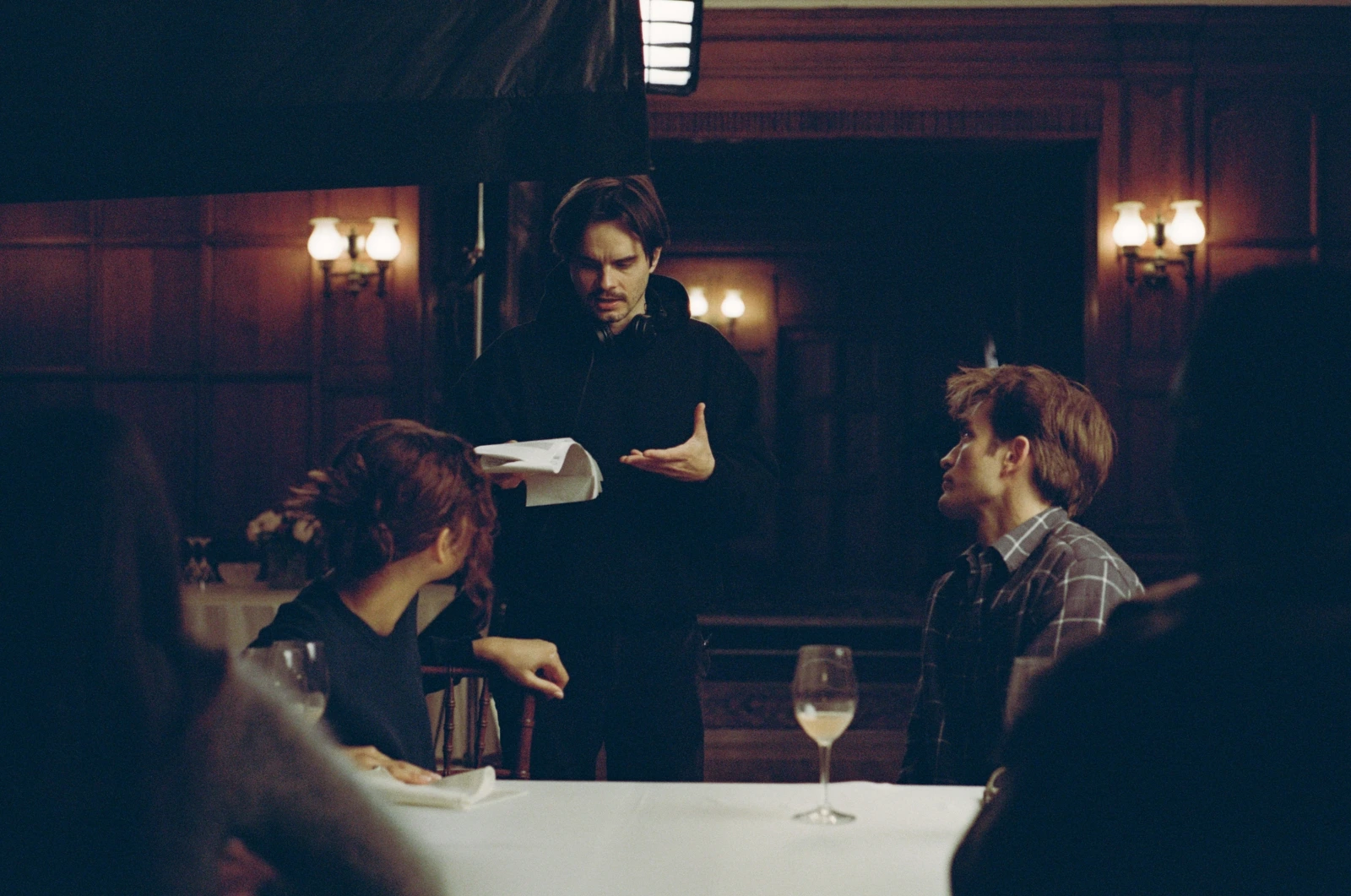
<p>The dialogue and acting are the real standouts, and honestly, they carry the entire runtime. Much of the film takes place around dinner tables and in living rooms, with conversation doing most of the heavy lifting. Some scenes are so tense, so painfully awkward, that it becomes physically hard not to look away. That only works because the performances are so committed. Zendaya and Robert Pattinson, in particular, give everything to their performances— often literally with their blood, sweat, and tears. Pattinson and Zendaya had a palpable chemistry throughout the entire film, and their acting absolutely <strong><em>carried</em></strong> the film on their backs.</p>

<figure>
  <img src="/assets/images/the-drama-bts.webp" alt="Kristoffer Borgli speaking to Zendaya and Robert Pattinson, who are sitting down at a dinner table." />
  <figcaption>Kristoffer Borgli directing Zendaya and Robert Pattinson</figcaption>
</figure>

<p>The editing also helps build and maintain tension and anxiety consistently throughout the film. Past and future moments cut in unexpectedly, offering premonitions and fragments of the past that keep the audience unsettled. Once the twist hits, the film spirals into a mess of tension and unpredictability that makes it hard to guess what’s coming next. The cinematography itself was not necessarily notable, but the film did look fantastic in its color grading, and the camera work shifted between tight closeups and handheld shots that added to the tension and detail of each scene.</p>

<p>I personally love dialogue-heavy films, and even though the plot is thin, the humor and tension in the dialogue give the movie a chaotic energy. It’s an entertaining train wreck, driven almost entirely by top-tier acting.</p>

<h2 id="negatives">Negatives</h2>

<p>Aside from the controversial premise and the central theme of unconditional love, <cite>The Drama</cite> falls a bit short. This is largely due to its thin plot and minimal characterizations.  Despite some fantastic dialogue scenes, the relatively short runtime still drags in the middle because the film leans so heavily on its twist.</p>

<p>For instance, we learn almost <em>nothing</em> about the characters or their emotional core. Zendaya’s character, at least, has her backstory revealed, and that helps to contribute to some character arc. Walking out of the theater, though, I realized we know virtually <em>nothing</em> about Pattinson’s character— no backstory, no grounding details, no subtle hints that give us something to hold onto. The reason we care at <em>all</em> about his character is purely because of the strength of his performance, which is undeniably excellent.</p>

<p>The film’s biggest weakness is that it probably would have worked better as a short film. It feels like everything was built around the twist, leaving a premise that might have been more effective in a tighter, more focused format. Then, at least, the issues with the films emotional depth and lack of characterization wouldn’t have been as glaring.</p>

<h2 id="conclusion">Conclusion</h2>

<p>The core of the film is its unpredictability, which is both a blessing and a curse. Once you know the twist, there’s not many reasons to revisit it. That’s not necessarily a bad thing; some movies are designed to shock and entertain in the moment, rather than reward repeated viewings. Still, the film might have had more staying power if it spent less time trying to be provocative and more time building depth.</p>

<p>Ironically, the movie isn’t all that edgy, anyway. If it wanted to truly lean into provocation, it has a long way to go compared to contemporaries who weave controversial themes directly into their characters and worldbuilding. Here, the controversy feels like the core, with the rest sort of loosely written up around it, rather than being <em>organically</em> built in to an already interesting story.</p>

<p>With more character depth, the themes (and especially the ending) would have felt much more <em>earned</em> and emotionally impactful. Ari Aster (who was a producer on <cite>The Drama</cite>) did this masterfully with <cite>Eddington</cite> and <cite>Beau is Afraid</cite>, which both ruminate on much more complex themes with much more depth. Even <cite>Bugonia</cite>, (made by a filmmaker <em>famous</em> for being emotionally obtuse and intentionally subversive) had more character depth and emotionality than <cite>The Drama</cite>— and it was certainly a much more fully-formed film overall.</p>

<p>In the end, <cite>The Drama</cite> is tense, sometimes funny, sometimes awkward, sometimes sweet, but it never quite reaches the heights of its hype or potential. With a stronger emotional core or richer characterization, it could have been fantastic, possibly even a contender for best of the year so far.</p>

<p>Instead, it’s a fun, chaotic film that most people probably won’t revisit. There’s not much to unpack once you’ve experienced the film once, since we never fully connect with or get to truly <em>know</em> the characters. The film’s core themes, though interesting, are obvious and were sadly written as fairly surface level. Still, I had a good time with the film. Pattinson and Zendaya absolutely carry the film with committed, impressive performances that are worth seeing on their own, and it’s certainly an interesting, wild ride.</p>]]></content><author><name>jeff</name></author><summary type="html"><![CDATA[Kristoffer Borgli is a filmmaker who enjoys ruminating on controversial themes and characters in darkly humorous ways, and The Drama continues the vaguely edgy, intentionally provocative vibe of his previous film, Dream Scenario. While this film makes for a wild, tense time at the theater— with the cast delivering some genuine career-high performances— it leans too heavily on a controversial twist, and doesn’t do enough with its characters to elevate its premise beyond basic musings on the limits of empathy and the nature of unconditional love. Still, I had a great time watching this film, and despite it not fully living up to the high expectations we all collectively imposed on it, the cinema experience was hilarious and supremely entertaining. You really have to experience a packed theater during this film— hearing and feeling the audience react to the chaos and audaciousness of the film in real time is definitely worth it.]]></summary><media:thumbnail xmlns:media="http://search.yahoo.com/mrss/" url="https://slowburn.mov/assets/images/the-drama.webp" /><media:content medium="image" url="https://slowburn.mov/assets/images/the-drama.webp" xmlns:media="http://search.yahoo.com/mrss/" /></entry><entry><title type="html">An Oddly Artistic Cinematic Niche</title><link href="https://slowburn.mov/an-oddly-artistic-cinematic-niche/" rel="alternate" type="text/html" title="An Oddly Artistic Cinematic Niche" /><published>2026-03-31T00:00:00+00:00</published><updated>2026-03-31T00:00:00+00:00</updated><id>https://slowburn.mov/an-oddly-artistic-cinematic-niche</id><content type="html" xml:base="https://slowburn.mov/an-oddly-artistic-cinematic-niche/"><![CDATA[<p>With the new film <cite>Our hero, Balthazar</cite> currently making its debut in select NYC theaters, we thought it would be a good time to discuss other films in this rather niche and controversial micro-genre. What sub-genre, you ask? Well, it may be more subtly referred to as the “mass casualty” indie film, but more colloquially, they are simply referred to as school shooter films.</p>

<h2 id="zero-day">Zero Day</h2>

<p><cite>Zero day</cite> is the first and perhaps the most powerful and experimental of the bunch of films we’re gonna be talking about today.</p>

<p>Released in 2003, it was conceived of and shot during a time when Columbine was still fresh in the cultural memory of America, and where the internet and news media had, in many ways, unfortunately deified the shooters and turned the entire situation into a twisted pop-cultural phenomenon. This, of course, begot more and more instances of tragedy across the country, whether through mental illness, the quest for infamy, or both.</p>

<p><cite>Zero Day</cite> could generally be perceived of as a found footage film, as the film is intentionally set up as if it was recorded by its two main antagonists, and it feels so much like lost Columbine footage that I’m sure when it was first released, many people felt like they had accidentally stumbled upon something actually sinister.</p>

<p>The film (although now missing its original, disconcertingly realistic mystique afforded to it by virtue of the early days of the internet) still feels like the most intimate portrayal of teen perpetrators ever put to screen. Although it feels like a found footage film, it has an uncomfortable and uncanny effect of very intentionally framing the audience as an invisible accomplice. It does this subtly, as the main characters record every aspect of their lives,  including their more innocent or mundane daily life events. Because the acting here is so absolutely fantastic for an entirely unknown and amateur cast,  the film is able to guide the viewer into an uncomfortable empathy with the film’s central antagonists. As we see their planning stages leading to their final action, it adds to the uncomfortable feeling that we are a sort of post-hoc accomplice to the tragic, violent actions they eventually take. So many times, it feels, we could have reached back to these kids, attempting to stop the events from happening, but it’s impossible. This has the effect of mimicking the feelings of the real-life friends and family of these types of perpetrators, who may ask themselves how this happened. We almost ask ourselves, despite everything, these people are still just disturbed kids who should have been saved from themselves.</p>

<p>As the story ramps up, it’s clear they’ve made their decision to go through with their actions, but the film decides to do something interesting when the violence actually begins. For nearly 10 minutes, our only perspective of the violence is through black and white security camera footage, keeping in line with the found footage or leaked footage aspect of the rest of the film. This footage is disturbingly similar to the real security footage from Columbine, giving the scene a cold authenticity. In the end, though, the result is a lot less intimate than the other films in the genre. I think it was a bold, stylistically consistent choice that contrasts the intimacy of the rest of the film, making the violence feel less exploitative than other films in the genre which use close up shots and handheld cameras.</p>

<p>Overall, though, I think the intimate nature of the rest of the film probably led to the sort of cult  romanticization of the main characters that we see online today,  which was certainly not a good thing. You can’t control the internet, though, and it’s pretty clear that the filmmakers didn’t think that the film would end up being such an aesthetic model for real life events and an obsessive cult fandom. Sadly, even as recently as this year, real life teens were unfortunately idolizing the film while attempting a copy cat event. Art imitating life, life imitating art.</p>

<p>The director of <cite>Zero Day</cite> went on to write <cite>The Place Beyond the Pines</cite>, which is another fantastic, gritty meditation on violence and familial trauma.</p>

<h2 id="the-dirties">The Dirties</h2>

<p>Another film we’re gonna be talking about today is <cite>the dirties</cite>, which went fairly unnoticed on its release and has sense developed a fairly large cult following thanks to the other works by the director, most notably, the films <cite>blackberry</cite> and the show <cite>Nirvana, the band the show</cite>.</p>

<p><cite>The dirties</cite> is as much a film about filmmaking as it is about violence in schools and bullying, and it spends much of its runtime actually being a meta-film about two students in high school who are shooting a film. Suitingly, this was also the reality of the filmmakers, who were shooting <cite>The Dirties</cite> in their school IRL,  where most of the students were not actors, and the teachers were not actors.</p>

<p>The film itself is about making a film about getting revenge on bullies, and <cite>The Dirties</cite> is as much a meta-commentary on film-obsession and filmmaking as it is the phenomenon of school shootings. The film shows us how the perfect storm of mental illness and bullying can fuel such heinous acts of violence, and how mental health issues go unnoticed in society even when they’re so glaringly obvious.</p>

<p><cite>The Dirties</cite> is an even more odd film in this lineup because it is also largely a comedy. I mean, it’s a buddy comedy about two kids struggling to fit in, and how they compartmentalize their real life and the lives they live on camera when making silly home movies. The comedic aspects actually take up the majority of the film, so when the violence finally happens in the final act, it makes it even more disturbing by contrast.</p>

<p>This contrast was definitely the intended effect. The violence is really only in the last few minutes of the film, and although there were clear signs that this mass-casualty event was going to happen, it’s still shocking when it finally shifts from laughter, friendship and filmmaking to such a terrible, life-ruining decision.</p>

<p>Unlike <cite>Zero Day</cite>, <cite>The Dirties</cite> uses a mix of placed action cameras and security footage during the shooting, giving it a more contrived but intimate feeling than <cite>Zero day</cite>. The camera work sort of reflects the disturbing compartmentalization of its main character, oscillating from the contrived, well placed GoPro shots, to standard follow shots which evoke the fact that the shooting is really happening.</p>

<p>The film doesn’t frame the shooter as a victim, but it is hard not to empathize with the character as he throws his entire life away instead of seeking help. For much of the film, we see him from an empathetic perspective, from his perspective as a bullied kid who’s actually very kind, but who’s obviously in need of adult intervention.  It’s clearly a story of mental illness going untreated, and people not paying attention to the very clear, very real warning signs of violent ideation. This is perhaps the most salient point of the entire film, and one that really reflects the current reality that allows these events to occur with such tragic regularity.</p>

<h2 id="elephant">Elephant</h2>

<p>Perhaps the most famous and lauded film based around school violence and the ghosts of  Columbine, is <cite>Elephant</cite> by Gus van Sant. It was, of course, a highly risky film for such a celebrated filmmaker to release at the time, but Gus has always taken risks. Whether it’s his creation of queer films in the early 90s, when reception was certainly more hostile than it is now, or whether it’s working with two brand new script writers on something like <cite>Good Will Hunting</cite>, Gus has had a rather iconoclastic career.</p>

<p><cite>Elephant</cite> itself is a very interesting film because it doesn’t delve into the psychology of school violence- it’s more of a conceptual, poetic piece. <cite>Elephant</cite> is a more mundane, polished, artsier look  into the average life of high schoolers, and how that mundanity and calm can so easily collide with violence.</p>

<p>In <cite>Elephant</cite>, the same 10 to 20 minute period before a school shooting takes place is  framed from the perspective of a variety of students across  the school and their everyday, typical student life.</p>

<p>The violence is not the center of the story, but it’s always there waiting. We know it’s coming, and it makes it more unnerving to see these kids going about their daily lives and their daily struggles while knowing that soon enough,  they will have to witness or be victim to something so heinous and so unbelievable.</p>

<p>When the film came out, it had mixed reception in terms of its casualness when relating to this controversial subject, but it was also celebrated for its juxtaposition of the mundane and innocent with the callous violence of school shootings.</p>

<p>While it seems airy and casual, the tension of the possibility or inevitability of violence is always there- something I’m sure kids can now relate to even more than before in America. The audience watches these kids live out their lives, with the palpable tension beneath the surface that the shooting is going to happen, and there’s nothing anyone can do about it.</p>

<p>Through Gus van Sant’s filmmaking, it’s impossible not to be absorbed into the interwoven moments of the students’ lives. So many of the shots feature long, beautiful walking scenes, taking the audience through these mundane trips through the entire school- whether that’s through empty fields or busy, loud hallways or a chaotic lunchroom, you’re always following these characters from behind in a truly voyeuristic manner. The school is alive, and the various perspectives that we follow make us feel more engrained into the school environment and culture, making the violence that closes off the last part of the film so much more disturbing.</p>

<p>Sant, much more than <cite>Zero Day</cite> or <cite>The Dirties</cite>, opts for realism during the violence, keeping the framing the same as the mundanity of the earlier shots. The deafening silence of the classrooms and hallways adds to the fear and terror the teens must be experiencing. The sound design for the gunshots is fierce, loud and encompasses everything.</p>

<p>When making <cite>Elephant</cite>, I think Gus understood that people are always looking for a definitive reason why these types of events occur, as a reason can help people more easily come to terms with the events. Unfortunately, there are never satisfying answers, as justifications for such violence simply don’t exist. When Columbine happened, the story was easy to understand: these kids were bullied, and this was their petty, evil revenge. However, as time went on, that narrative became less and less credible, and in the end, we were left with no conceivable justifications for their violent actions at Columbine. Sants idea to forgo the psychology or moral questions was rather smart, in hindsight. He instead gave us the more  terrifying experience of witnessing high schoolers  going about their naive innocence, and having to experience their entire world being shattered by violence. No answers, no reasons.</p>

<h2 id="polytechnique">Polytechnique</h2>

<p><cite>Polytechnique</cite>, unlike the others, is based on the irl accounts of the actual survivors of a mass casualty event at a Canadian university. It chooses to open on the seemingly random act of violence on campus, then, it goes back to the hours before the shooting occurred, shifting perspectives between the shooter, and his victims.</p>

<p>It’s shot in black and white, which feels as if it reflects the lack of hope and nihilism of its shooter. Even more than <cite>Elephant</cite>, it’s more of an art film than the others in the genre, and it goes into the more psychological and political motivations of the shooter, drawing a straight line between ideology and violence.</p>

<p>The main character writes a manifesto, clearly outlining exactly why he believes he is justified,  how even a self described rational person can commit these types of actions. In his case, it was a reactionary, anti-feminist hatred that fueled his violence.</p>

<p>The film jumps from his perspective to that of the women who would end up having to endure the shooting, Juxtaposing between the mundanity, friendships, innocence and the casual sexism occurring in the women’s daily lives to the irrational, violent misogyny that the shooter professes.</p>

<p>The main character is clearly unwell, despite his own estimation of being rational, and the film constantly shows his inability to see a future, his loneliness, and his utter lack of connection with those around him. He stews in his hatred, and is constantly glaring at others as if grasping at the last hope for someone to truly see him. In his estimation, he is a failure due to the world changing, not due to his own lack of effort or talent.</p>

<p>Unfortunately, his spiral toward misanthropy becomes everyone else’s nightmare, and the film does not hold back, detailing the violence with a cold, calculated framing that never pulls away from the carnage, and unlike the other films, the violent act itself is outlined with graphic detail for nearly half the film.</p>

<p>The film has mixed reviews, likely due to its arthouse vibes and unblinking violence, but it does a very good job of profiling an unfortunately common descent into violence. The film is praised more so for humanizing the victims and and keeping them at the center of the story, which is something the other films in the genre generally don’t do.</p>

<p>It’s probably the most controversial film here simply because of its excess of violence, which is only made more disturbing as the shooter clearly targets helpless, terrified women. Denis is known for his intentional, dramatic minimalism and his use of beautiful static wide shots. From <cite>Polytechnique</cite> to <cite>Prisoners</cite> to <cite>Dune</cite>, regardless of the budget, there’s always been a show-don’t-tell ethos that some have found boring, but I’ve always found fascinating in a way that’s very similar to Alex Garland. He excels in aesthetics, visual storytelling and world building, and all of his films are gripping no matter what genre they are. <cite>Polytechnique</cite> is certainly more arthouse, but it’s the beginning of a clear artistic vision that continues to impress.</p>

<h2 id="our-hero-balthazar">Our Hero, Balthazar</h2>

<p>Time will tell where <cite>Our Hero, Balthazar</cite> fits into this sub-genre, but from the ironypilled sarcastic trailers, I would assume it’s somewhere between <cite>The Dirties</cite> and <cite>Zero Day</cite>. So far, it looks like an edgy, unblinking look into Internet culture, isolation, and violence perpetrated through nihilism. If that is the case, it’s a strong foundation, and ground that hasn’t really been covered in this genre of films. Hopefully we can see it soon, as the director has been involved in some of the best indie films of the last decade.</p>]]></content><author><name>jeff</name></author><summary type="html"><![CDATA[In anticipation of the upcoming film Our Hero, Balthazar, we take a deep dive into the visual language and narrative structures of four influential films that all grapple with this tragic subject: Zero Day (2002) by Ben Coccio, Elephant (2003) by Gus Van Sant, Polytechnique (2009) by Denis Villeneuve, The Dirties (2013) by Matt Johnson]]></summary><media:thumbnail xmlns:media="http://search.yahoo.com/mrss/" url="https://slowburn.mov/assets/images/an-oddly-artistic-cinematic-niche.webp" /><media:content medium="image" url="https://slowburn.mov/assets/images/an-oddly-artistic-cinematic-niche.webp" xmlns:media="http://search.yahoo.com/mrss/" /></entry><entry><title type="html">Project Hail Mary</title><link href="https://slowburn.mov/project-hail-mary/" rel="alternate" type="text/html" title="Project Hail Mary" /><published>2026-03-26T00:00:00+00:00</published><updated>2026-03-26T00:00:00+00:00</updated><id>https://slowburn.mov/project-hail-mary</id><content type="html" xml:base="https://slowburn.mov/project-hail-mary/"><![CDATA[<p>It’s already rare for a modern big-budget Hollywood production to adapt a book that results in a feature with a largely solitary character. It’s even more rare for that level of  production to forego the use of green screens and opt for an entirely practical set. For those reasons alone, I have to respect <cite>Project Hail Mary</cite> as something of a Hail Mary itself, regardless of any other aspect of the film.</p>

<p>As a film of pure spectacle, it features beautiful, busy, and surprisingly experimental set design and cinematography. It’s no surprise that the unique cinematography is one of the main draws, as it shares its cinematographer (Greig Fraser) with the <cite>Dune</cite> films. Many shots feature countless, dizzying layers of lighting, glass, projections and aesthetically wild framing, especially in the earlier parts of the film when we are first being introduced to the spaceship.</p>

<p>I was originally skeptical of the marvel-style sidekick Rocky that was prominently displayed in trailers for the film, but even that cynicism sort of melted away when I found out that Rocky, too, was totally puppeteered throughout the film. Even the decision to maintain Rocky’s abstract design- faceless, and designed as some strange mix of spider and rock- deserves some serious credit for falling far outside the bounds of the typical Hollywood sensibilities for a film this large. Rocky largely works as the likable, childlike sidekick of the film’s protagonist, which is great for a family film.</p>

<p>Now, does the film have issues? Of course. It’s a crowd pleaser, and it’s absolutely formulated as a family film. Characterization and character arcs are minimal at best, with most of what we learn being fed through flashbacks to the days before Ryan Gosling’s character was sent to space to ostensibly save the world from a mysterious star-eating life-form. There are moments of drama scattered across the film, but they never quite break through to any significant heartache because the film simply did not prioritize emotional depth.</p>

<p>What it did prioritize was spectacle, and in this case, I think the spectacle was worth the cost of admission, especially when compared to the comparatively depthless void that are Marvel and DC films.</p>

<p>These days, there are few crowd pleasers that have at least some artistic merit. <cite>Project Hail Mary</cite> was obviously crafted with a very talented team across the board, and they took significant risks in wanting to deliver a film that honored the tradition of practical effects and would fit within the existing cannon of dramatic, crowd pleasing space films. <cite>Project Hail Mary</cite> succeeds in that regard, and in some ways, it reminded me of <cite>Castaway</cite>, Wilson and all.</p>

<p>Does it venture into reddit-joke territory? Of course, it’s about a high-school science teacher befriending a pet rock. But, taken in the genre that it’s in- family crowd-pleasers- it absolutely punched above its weight. Ryan Gosling also went above and beyond the Ken-doll performance I thought he would give, and at points, delivered a surprisingly emotional performance in contrast to the script he was given, which was goofy, unbelievable, and an obviously escapist fantasy for all audiences.</p>

<p>If you can shelve pretension and cynicism for 2.5 hours, you will probably enjoy the film enough to walk away happier than when you came in. If you go in expecting <cite>2001 A Space Odyssey</cite>, of course you will leave disappointed, but that should be obvious.</p>]]></content><author><name>jeff</name></author><summary type="html"><![CDATA[It’s already rare for a modern big-budget Hollywood production to adapt a book that results in a feature with a largely solitary character. It’s even more rare for that level of production to forego the use of green screens and opt for an entirely practical set. For those reasons alone, I have to respect Project Hail Mary as something of a Hail Mary itself, regardless of any other aspect of the film.]]></summary><media:thumbnail xmlns:media="http://search.yahoo.com/mrss/" url="https://slowburn.mov/assets/images/project-hail-mary.webp" /><media:content medium="image" url="https://slowburn.mov/assets/images/project-hail-mary.webp" xmlns:media="http://search.yahoo.com/mrss/" /></entry><entry><title type="html">The Drama: A24 Wedding Pop-Up</title><link href="https://slowburn.mov/the-drama-wedding-pop-up/" rel="alternate" type="text/html" title="The Drama: A24 Wedding Pop-Up" /><published>2026-03-14T00:00:00+00:00</published><updated>2026-03-14T00:00:00+00:00</updated><id>https://slowburn.mov/the-drama-wedding-pop-up</id><content type="html" xml:base="https://slowburn.mov/the-drama-wedding-pop-up/"><![CDATA[<p>A24 staged a pop-up event to promote <cite>The Drama</cite> in the eloping capital of the world. A couple of weeks ago, they <a href="https://web.archive.org/web/20260228160112/https://thedramaweddingchapel.com/">put up a website</a> for people to apply to get married at the event.</p>

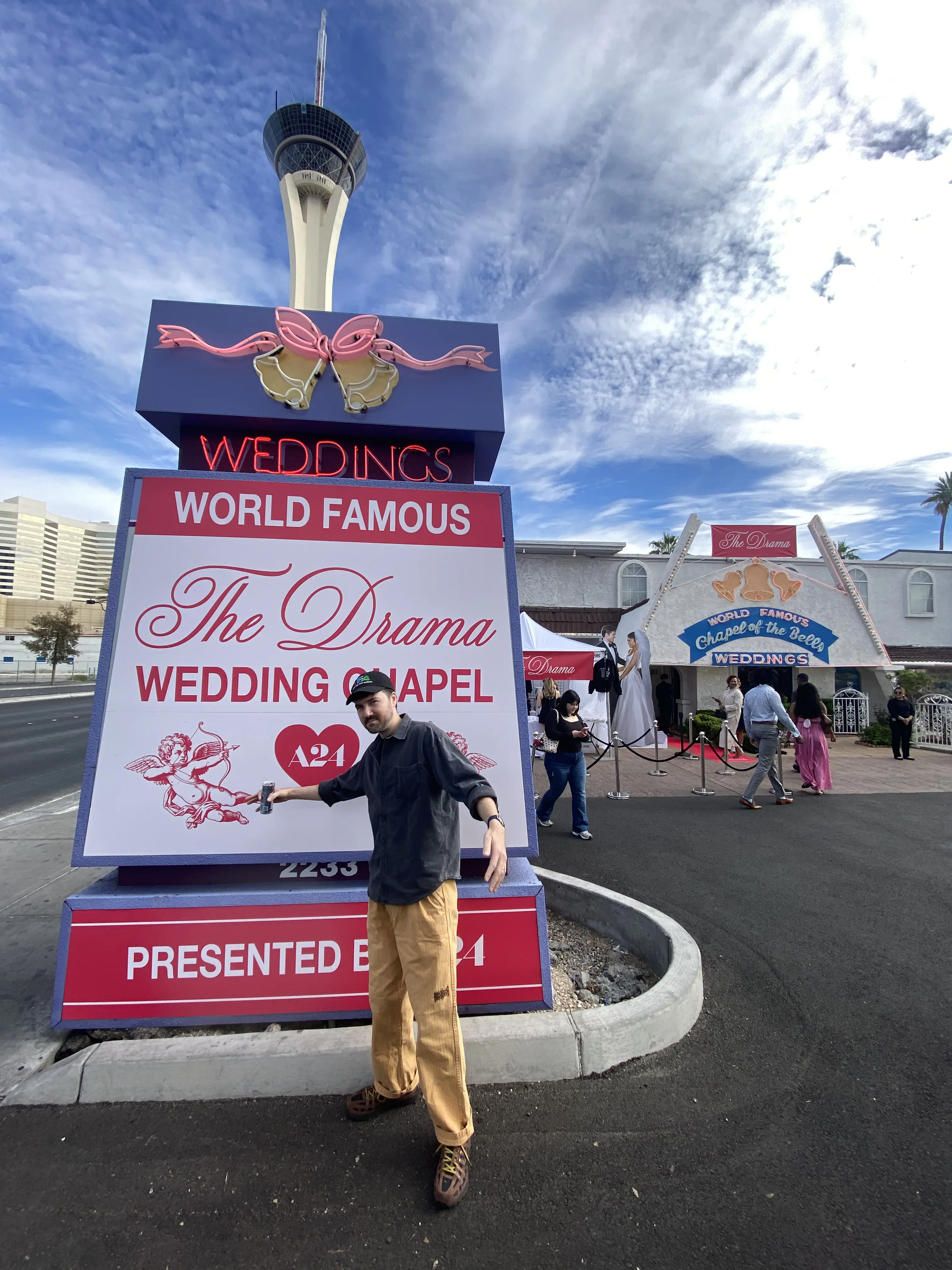
<p>We arrived before the start time. It was a tense, but jovial atmosphere as like-minded cinephiles took photos, bought exclusive merch, and waited to discover what was going to happen.</p>

<figure>
  <img src="/assets/images/the-drama-event-slowburn.webp" alt="Slowburn contributor standing in front of the sign for the wedding chapel pop up event." />
  <figcaption>Slowburn at The Drama event.</figcaption>
</figure>

<p>Around 10:15am or so, a line of blacked out SUVs pulled into the parking lot. Alana Haim (<cite>Licorice Pizza</cite>, <cite>One Battle After Another</cite>) exited one car and entered the chapel. Following soon behind, Zendaya (<cite>Euphoria</cite>, <cite>Challengers</cite>, <cite>Dune</cite>) did the same. In a funny surprise, the crowd was essentially rendered speechless. No one was brave enough to make a peep as she effortlessly glided by, into the building.</p>

<p>Alana and Zendaya joined the wedding inside, acting as witnesses and helping to officiate in some capacity, while the crowd outside mingled about. After the wedding, they came back out and took official photos in front of the signage. The newlyweds appeared from the chapel and the actors cheered, the crowd joining in. Alana and Zendaya made their exit. A few were brave enough to utter some “I love you’s” this time.</p>

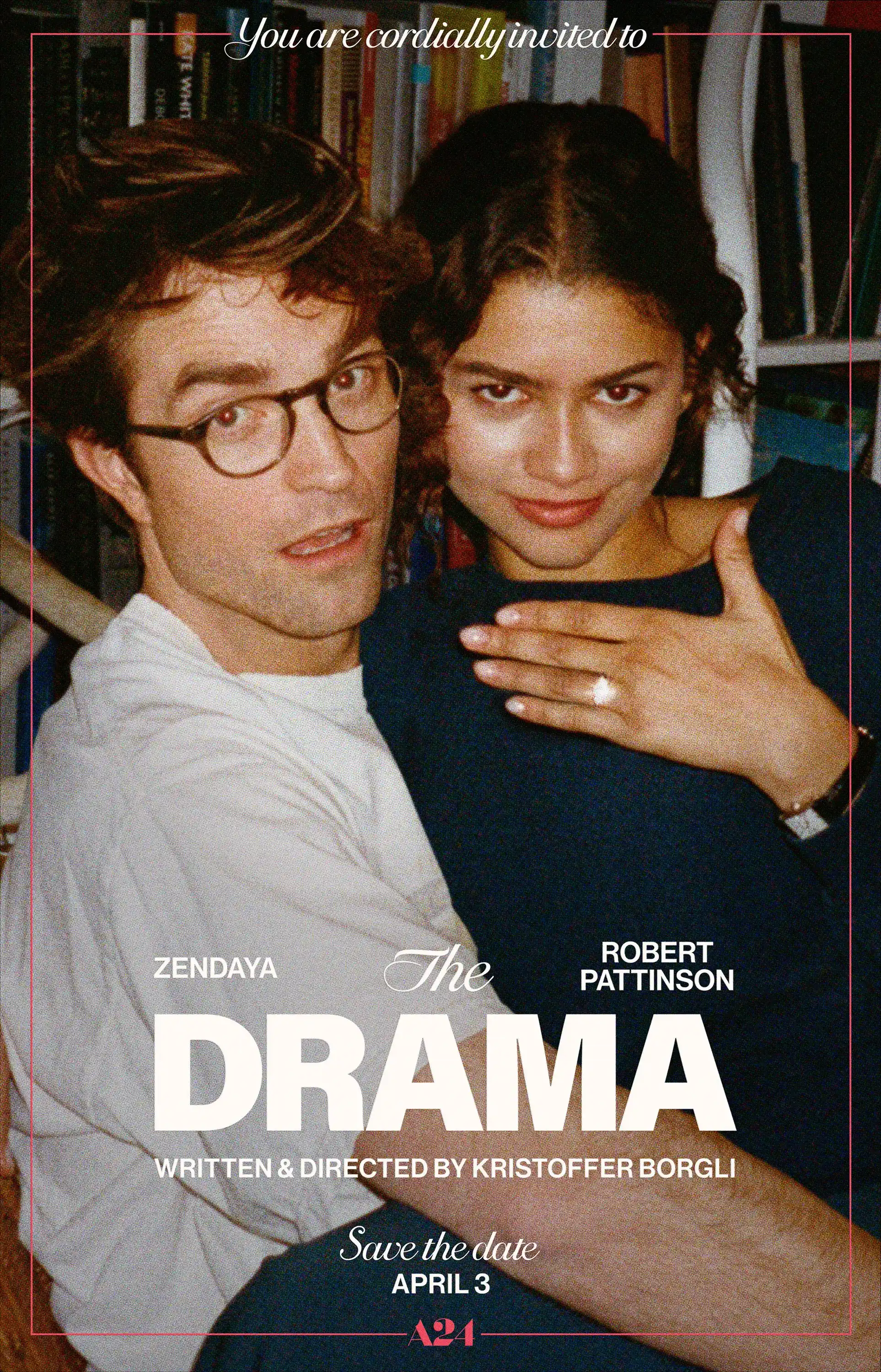
<p><cite>The Drama</cite> releases on April 3rd of this year.</p>

<figure>
  <img src="/assets/images/the-drama-poster.webp" alt="Robert Pattinson and Zendaya sitting together. Zendaya holding up her hand showing an engagement ring on it." />
  <figcaption>The Drama poster.</figcaption>
</figure>]]></content><author><name>cale</name></author><summary type="html"><![CDATA[A24 put on an event in Las Vegas at Chapel of the Bells to promote their new film The Drama (2026). Zendaya and Alana Haim visited.]]></summary><media:thumbnail xmlns:media="http://search.yahoo.com/mrss/" url="https://slowburn.mov/assets/images/the-drama-event-yt-thumb.webp" /><media:content medium="image" url="https://slowburn.mov/assets/images/the-drama-event-yt-thumb.webp" xmlns:media="http://search.yahoo.com/mrss/" /></entry></feed>